Study on Attraction No. 2 — Angle
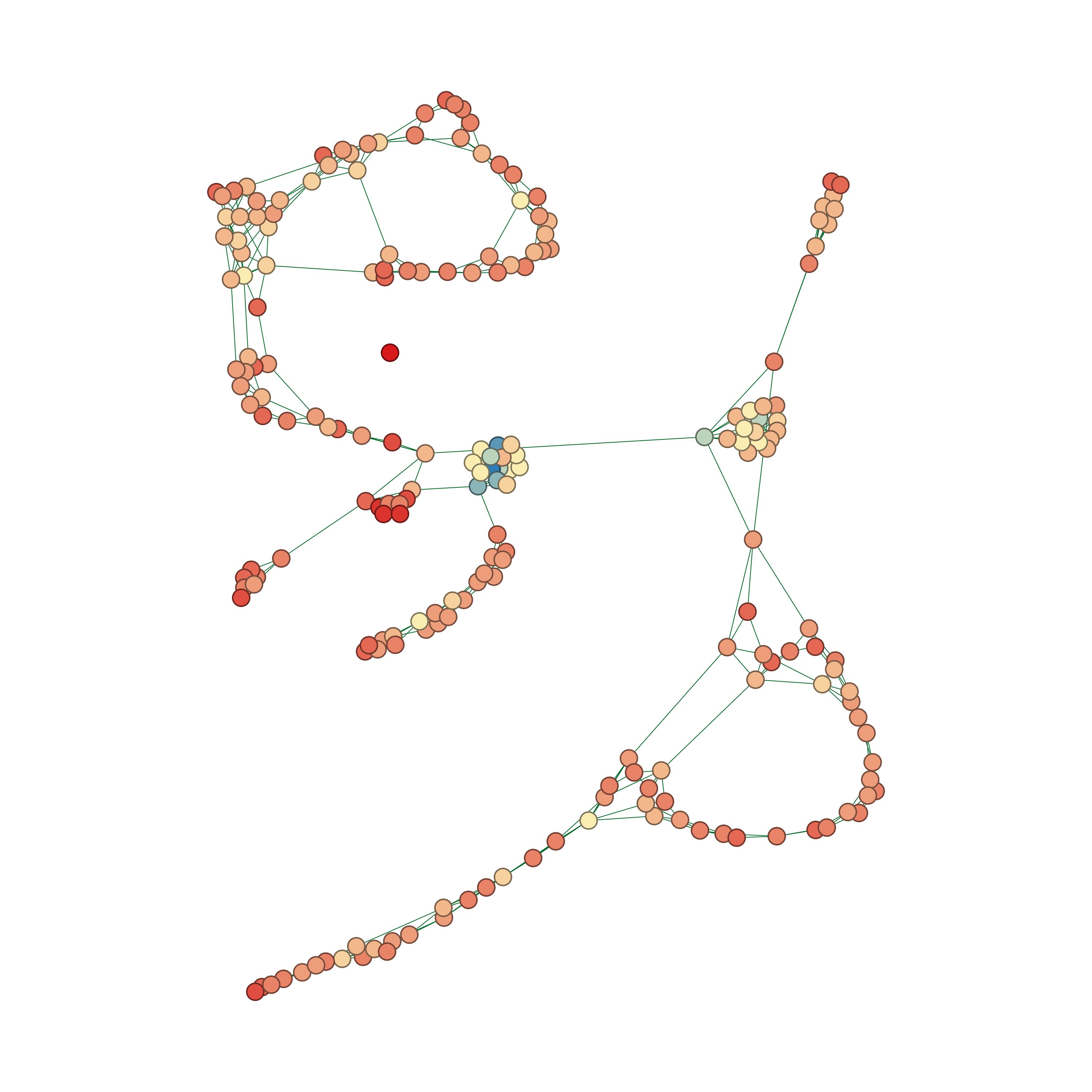
We are not observing matter. We are observing the shape that matter can take.
This graph doesn't depict atoms. It depicts folds.
The molecules shown here are built from the same fundamental elements. What distinguishes them is not so much the matter they're made of, but the way that matter takes shape in space.
A sheet of paper can become a crane or a boat. The paper is the same; only the angles of the folds change. Yet the crane and the boat are not the same object. They have a different shape, a different function, a different way of existing.
Something similar happens with these molecules.
Their shape arises from a sequence of folds. Each fold can open or close by a few degrees, but even a minimal variation can transform the molecule's entire geometry. And when the geometry changes, so does what the molecule is able to do: recognising another molecule, or not; binding to a receptor, or brushing past it with no effect at all. Sometimes the difference between acting and not acting is contained within a few degrees.
This is why the graph observes angles.
Not because atoms are irrelevant, but because angles tell the shape. And the shape tells the function.
Each edge doesn't represent a chemical bond. It represents a statistical dependency: when one fold changes, which others tend to change with it? Which parts of the molecule seem to answer to the same rhythm? The drawing doesn't follow the chemistry of bonds, but the geometry of transformations.
The molecules involved in this phase are covered in the Method.
Not all these relations carry the same degree of certainty, and this difference is stated openly. For some molecules, the synchronism emerges from experimental data. For others, where the data isn't yet sufficient, it is estimated from their structure, introducing an explicitly reported margin of noise. The uncertainty isn't hidden: it's part of the work's language.
Attraction, then, can be imagined as a moment in which many folds, though belonging to different molecules with no direct bond between them, begin to answer to the same cadence.
This graph tries to make exactly that instant visible.
Not to definitively explain attraction.
But to come closer to what still escapes us.
Because every inquiry begins this way: searching for a shape for what we cannot yet see.
The works
-
Study on Attraction No. 2 — Angle
-
Study on Attraction No. 1 — Shape
-
Study on Attraction No. 3 — Shape and Error
-
Study on Attraction No. 4 — Angle and Error
